

Best diamond wedding band styles for women in 2026
Best overall: a prong-set half-eternity band. Best for a protected diamond row: a channel-set band. Best for continuous diamond coverage: a full-eternity band. This 2026 guide compares diamond wedding band styles by comfort, engagement-ring fit, and how you plan to wear them.
- Half-eternity leads diamond wedding band styles for shoppers who want diamonds across the top and plain metal underneath.
- Choose channel settings for recessed diamonds, full eternity for continuous coverage, and contour bands for engagement-ring clearance.
- Tringa Jewelers suits wedding band shoppers seeking personal help choosing or designing a piece.
- Compare wedding bands beside your engagement ring, then confirm sizing and setting details before ordering.
Why this matters
The best wedding band fits your engagement ring and your hand—not just your preferred photograph. A diamond row that looks delicate alone can feel crowded beside a wide engagement-ring shank. A curved band can solve a fit problem but look different when worn by itself.
For Staten Island customers and online shoppers across the United States, Tringa Jewelers offers fine jewelry and custom orders. Personal help choosing or designing a piece is especially relevant when you need to compare a wedding band with an existing ring.
For your 2026 shortlist, separate three decisions: diamond coverage, stone setting, and band shape. Half-eternity describes coverage; channel describes a setting; contour describes shape. These categories overlap, so the ranking below gives each style a distinct buying purpose rather than treating them as mutually exclusive.
What makes the best diamond wedding band styles
- Ring compatibility: The band should sit beside your engagement ring without forcing an unwanted gap or pressing against exposed details.
- Diamond coverage: Decide whether you want diamonds across the visible top or around the entire circumference.
- Contact comfort: Examine the band edges, prongs, and surfaces that touch neighboring fingers.
- Sizing flexibility: Ask what size adjustments the exact design permits. Do not assume every diamond band can be resized.
- Solo appearance: Consider whether the wedding band also looks right when you leave your engagement ring off.
- Care access: Choose a setting you can inspect and clean according to the jeweler's instructions.
Diamond wedding band styles at a glance
| Rank and style | Best for | Standout feature | Key limitation |
|---|---|---|---|
| 1. Prong-set half-eternity | A first wedding-band shortlist | Diamonds across the upper portion, plain metal below | Turning can expose the plain section |
| 2. Channel-set | A recessed diamond row | Diamonds sit between metal walls | Metal borders create a more structured appearance |
| 3. Full-eternity | Continuous diamond coverage | Diamonds continue around the circumference | Resizing is often restricted |
| 4. Contour | Clearance around an engagement-ring head | Curved or notched profile | Fit depends on the exact engagement ring |
| 5. Bezel-set | Defined stone outlines | Metal rims surround individual diamonds | Rims change the visible outline of each stone |
| 6. Pavé | Fine-textured diamond detail | Closely arranged small diamonds | Small settings require careful inspection |
1. Prong-set half-eternity: best for a first shortlist
A prong-set half-eternity band places diamonds across the upper portion of the ring and leaves plain metal underneath. Prongs hold the stones, while the partial coverage gives you a useful starting point for comparing diamond wedding bands.
Best for: You want visible diamonds without stones continuing beneath your finger.
Prong-set half-eternity pros:
- Plain metal sits against the underside of your finger.
- You can compare different diamond sizes within the same basic layout.
- Partial coverage leaves an undecorated section to discuss when asking about resizing.
Prong-set half-eternity cons:
- Rotation exposes the plain section.
- Raised or worn prongs can catch fabric and need attention.
For a 2026 wedding-band search, start here unless continuous coverage is your priority. Ask where the diamonds end on your actual ring size; a front-facing photograph does not show that boundary clearly.
Verdict: Buy a prong-set half-eternity band if you want a practical default, after confirming comfort and fit.
2. Channel-set: best for a recessed diamond row
A channel-set band holds diamonds between parallel metal walls. The setting creates a defined strip of diamonds without individual prong tips projecting above each stone along the top row.
Best for: You prefer a structured band with metal borders beside the diamonds.
Channel-set pros:
- Metal walls shelter the sides of the diamond row.
- The uninterrupted borders give the band a clear outline.
- The setting avoids exposed individual prong tips across the row.
Channel-set cons:
- The metal borders make the band look more enclosed than an open prong setting.
- Dirt beneath the stones still needs cleaning; the channel is not a sealed enclosure.
Try the channel band beside your engagement ring rather than judging it alone. Its straight borders can either reinforce a clean-lined ring or feel visually heavy next to a very fine shank.
Verdict: Buy a channel-set band if recessed diamonds and a defined metal outline match your priorities.
3. Full-eternity: best for continuous diamond coverage
A full-eternity band carries diamonds around the entire circumference. It suits shoppers who want the diamond pattern to continue even when the ring turns on the finger.
Best for: You want continuous coverage rather than a plain underside.
Full-eternity pros:
- Rotation does not reveal a plain-metal section.
- The diamond pattern continues around the ring.
- The band gives you an uninterrupted diamond look when worn alone.
Full-eternity cons:
- Resizing is often restricted by the continuous setting.
- Stones and settings beneath the finger remain exposed to contact during wear.
Confirm the exact size before choosing full eternity. Ask how the particular design handles future sizing needs, and assess the setting against neighboring fingers. Continuous coverage is an appearance choice, not an automatic comfort upgrade.
For a 2026 purchase, make fit the deciding factor rather than choosing full eternity solely because it contains diamonds all the way around.
Verdict: Buy full eternity only when continuous coverage outweighs sizing flexibility for you.
4. Contour: best for engagement-ring clearance
A contour band uses a curve, notch, or angled profile to accommodate an engagement-ring head. The shape can bring the rings closer together where a straight band would leave a gap.
Best for: Your engagement ring's outline prevents the straight-band fit you want.
Contour pros:
- A shaped profile can accommodate a projecting center setting.
- The band can repeat an engagement ring's curved or pointed outline.
- You can choose the shape around the relationship between both rings.
Contour cons:
- A contour that fits one engagement ring does not necessarily fit another.
- The curve or notch remains visible when you wear the band alone.
Examine the pair from above and from the side. A close-looking fit in a top-down photograph does not establish clearance beneath the center setting, especially around a basket or halo.
Verdict: Hold a contour-band purchase until you confirm its shape against your exact engagement ring.
5. Bezel-set: best for clearly outlined diamonds
A bezel-set band uses metal rims around individual diamonds. Depending on the design, those rims create a repeating pattern of rounded or geometric stone outlines.
Best for: You want each diamond framed by a distinct metal edge.
Bezel-set pros:
- Metal surrounds the diamond edges.
- The setting does not rely on projecting prong tips around each stone.
- Individual rims create a recognizable pattern across the band.
Bezel-set cons:
- The rims alter how much of each diamond's outline remains visible.
- Spaces between bezels can collect residue and still need cleaning.
Compare the bezel band's outer edge with your engagement-ring shank. A scalloped outline looks different from a straight diamond row, even when both use round stones.
Verdict: Buy a bezel-set band if framed diamonds matter more to you than an open-prong appearance.
6. Pavé: best for fine-textured diamond detail
A pavé band arranges small diamonds closely together and secures them with small beads or prongs of metal. The effect emphasizes a fine diamond surface rather than a row of individually prominent stones.
Best for: You want small-scale diamond detail beside an engagement ring.
Pavé pros:
- Small diamonds create a closely spaced pattern.
- The texture can echo a diamond-set engagement-ring shank.
- Different coverage layouts let you separate texture from eternity coverage.
Pavé cons:
- Small settings need inspection for wear or loose stones.
- A fine appearance does not establish strength; construction still matters.
Do not select pavé from the word alone. Ask about band width, setting height, and contact between the wedding band and engagement ring before making your choice.
Verdict: Buy pavé if fine diamond texture is your goal; skip designs that feel sharp or crowd your existing ring.
How we ranked these styles
The ranking prioritizes engagement-ring compatibility, contact comfort, coverage, and sizing questions. Half-eternity leads because it offers a straightforward starting point; the remaining positions identify specific reasons to choose a different style.
This is a style guide, not a wear-test result or a claim that one setting is always stronger. Construction and fit decide the final choice.
Build a stack that works together
Choose the wedding band before adding another decorative ring. Establish how the engagement ring and wedding band sit together, then decide whether another layer improves the arrangement or simply adds width.
The distinction between stacking ring styles matters because texture, outline, and spacing change the appearance of the whole stack. Repeating pavé creates continuity; pairing different outlines creates contrast. Neither approach excuses uncomfortable contact between settings.
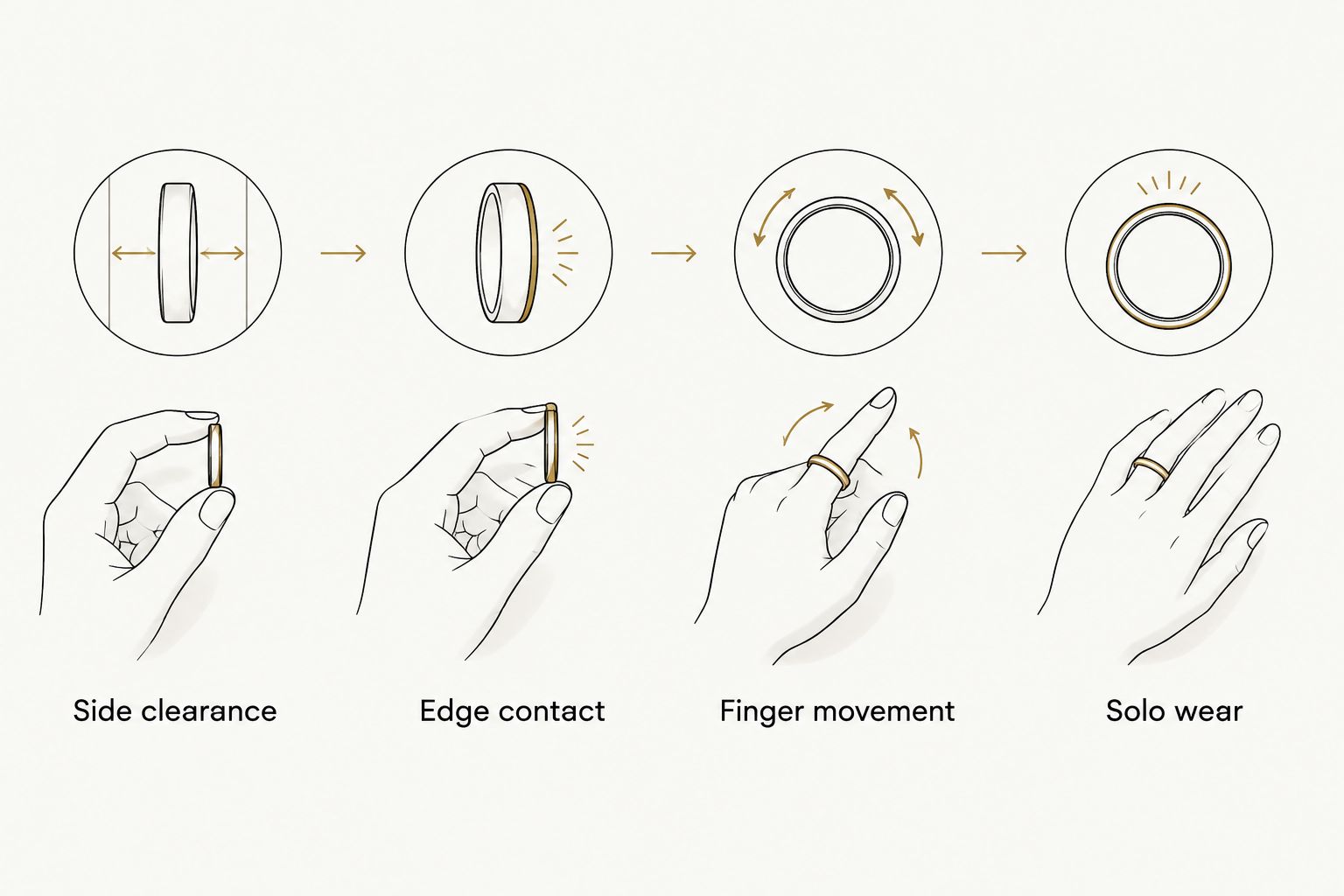
For your 2026 comparison, check these details in order:
- Side clearance: Look beneath the engagement-ring head, not just at the top view.
- Edge contact: Identify whether a diamond edge or projecting setting touches the neighboring ring.
- Finger movement: Bend your finger and check pressure between the stacked bands.
- Solo wear: Remove the engagement ring and judge the wedding band by itself.
For an online inquiry, include clear top and side photographs of your engagement ring. State whether you want a flush-looking fit, accept a visible gap, or plan to wear the wedding band alone regularly. Those details make your request more specific than asking for a matching band.
Compare a separate band with a bridal set
If you have not chosen an engagement ring, compare a bridal set before committing to separate pieces. A set lets you consider both rings together, but you still need to confirm what the order includes and how the pair fits.
Tringa Jewelers lists the Halo Design Natural Diamond Bridal Set in solid 14K yellow gold with 0.50 carats of natural diamonds. Its description explicitly includes an engagement ring and wedding band.
The Princess Cut Diamond Halo Bridal Ring Set is described in 14K white gold with 1.00 carat total weight across the engagement ring and matching wedding band. That total is not the wedding band's diamond weight alone.
| Bridal set | Best for | Stated detail | Buying limitation |
|---|---|---|---|
| Halo Design Natural Diamond Bridal Set | Comparing both rings in yellow gold | Engagement ring and wedding band included | Combined diamond weight does not isolate the band's weight |
| Princess Cut Diamond Halo Bridal Ring Set | Comparing a princess-cut halo set in white gold | Matching wedding band described | Combined diamond weight is not a center-stone measurement |
Bridal-set pros: You can evaluate a coordinated pair and discuss both pieces in one inquiry. Bridal-set cons: The included band's appearance still needs to suit you on its own, and combined specifications require careful reading.


Which diamond wedding band style should you choose?
Choose prong-set half-eternity as your default, then change the style only for a clear reason. Choose channel for a recessed row, full eternity for continuous coverage, contour for clearance, bezel for framed stones, or pavé for fine texture.
For a 2026 inquiry with Tringa Jewelers, name your preferred style, metal color, and existing engagement ring. Ask for personal help comparing a separate women's diamond band, an eternity band, or a custom piece. Confirm the exact specifications before ordering.
FAQ
What's the best diamond wedding band style for a first shortlist?
A prong-set half-eternity band is the best starting point in this guide. It combines diamonds across the upper portion with plain metal underneath; confirm where the diamonds end on your ring size.
Is a full-eternity band better than a half-eternity band?
Full eternity is better for continuous diamond coverage, not automatically for comfort or sizing flexibility. Half-eternity leaves a plain section underneath, while full-eternity resizing is often restricted.
Which diamond wedding band fits a low-set engagement ring?
A contour band is worth comparing when a low-set engagement ring prevents the straight-band fit you want. Confirm the curve or notch against the exact ring and inspect clearance from the side.
Can I resize a diamond eternity wedding band?
Resizing depends on the exact eternity-band construction, and full-eternity designs often have restrictions. Ask about the particular ring before ordering rather than assuming a later adjustment is possible.
Is channel-set better than pavé for a wedding band?
Channel-set is better if you prefer diamonds recessed between metal walls; pavé is better if you want fine-textured diamond detail. Neither setting name alone establishes durability or comfort.
Should I buy my wedding band with my engagement ring?
Compare both together whenever possible, whether you choose separate rings or a bridal set. Check side clearance, setting contact, and how the wedding band looks alone.
Can Tringa Jewelers help me choose or design a wedding band?
Tringa Jewelers offers personal help choosing or designing a piece and accepts custom orders. Describe your preferred wedding-band style and existing engagement ring when making an inquiry.
One last thing
A visible gap is not automatically a fit problem. Rings that touch in a photograph are not necessarily better suited to wearing together. Decide whether you prefer a gap or a shaped band, but reject unwanted pressure between the settings.